- Aug 20
Why Competition doesn't have to mean conflict: finding your place in the floral industry
- 0 comments
Photo by Snap Wander on Unsplash
Three months after I'd established my Sunday Flower shop at Brewtown Farmers Market, a florist from a neighbouring town appeared as a vendor selling single variety bunches of flowers still in their plastic wrappers.
Suddenly fresh flower sales dropped 50% from a healthy four-week average of $1080, just as the full flush of summer flowers had started. Apart from the obvious irritation of having a new competitor, it rattled me that such a vendor was allowed at a farmers market at all.
I rang a florist mentor of mine. Her answer to my moaning was that now I knew what it was like when a flower farmer starts selling cheaper flowers via local shops, killing a florist's walk-in trade. I went quiet on the phone for a moment, taking in the criticism.
Around the same time, my wholesale florist customer lamented the arrival of a doorstep flower market set up by a local retailer, a two-block walk from her floral studio. This had also killed her walk-in trade.
And while we lamented a common problem, it opened up another line of complaint: flower farmers selling buckets of flowers at wholesale prices to people who want to arrange their own, undercutting florist wedding flowers.
Here I was, facing a meltdown in my Sunday trade, but with a clear view of a real pinch point in the floral industry.
Competition can be the lifeblood of a healthy industry, and it certainly jump-started me out of complacency as a resident farmers market vendor. But what's fair and reasonable when it comes to competition depends on which side of it you're standing on.
As a business coach to flower farmers, I know first-hand that competition, and knowing where we fit in the wider flower industry, can feel like an intractable problem, even when people were playing to their strengths and building a distinctive business.
Fast forward six months, and the answer came to me in the middle of a business retreat for flower growers focused on selling retail. I realised I'd been looking at the whole question of growers selling directly completely wrong.
Instead of seeing competition for flower sales as a conflict in the floral industry that needed a cease-fire, for the first time I could see what claiming our space in the wider industry actually looked like. I'd scribbled a new market map on the whiteboard and there was a palpable sense of relief in the room.
For the first time, every grower in that room could pinpoint exactly their place in the floral industry that they wanted to claim as their own.
Here's what that scribble looked like then, and how it's developed into the diagram I now use to explain what it means to find a niche in the floral industry, and the business model you can build around it.
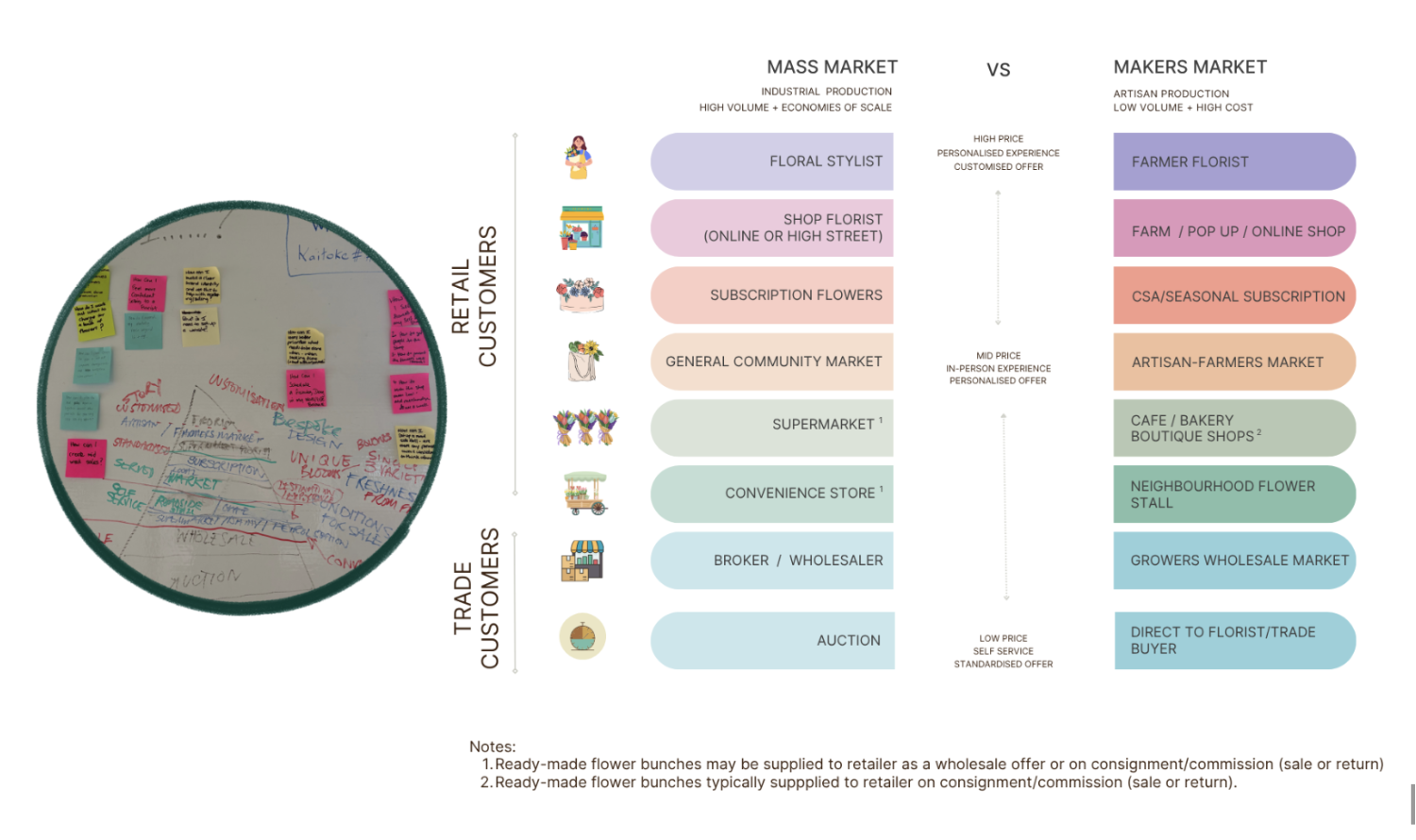
This distinction between mass market and makers market isn't revolutionary - other creative and craft industries figured this out long ago. Yet, I think what it shows flower farmers and garden growers what is our commercial difference, more clearly than before.
It doesn't take away the competition, or the questions about pricing and services. What it means is that we don't have to keep second-guessing ourselves, or comparing ourselves to bigger-scale growers or local florists.
I know what it's like to have your business destabilised when a competitor turns up on your patch, and to struggle defining your business's shape around your own strengths. Those feelings don't go away, in my experience. You get better at recognising them for what they are, and then moving on to focus on what your business needs from you.
Through all of this, here's what I've learned about finding your place in the flower industry.
As a small-scale or seasonal grower, it's worth remembering that we don't fit neatly into the mass market industry, but we can thrive in our own niche, what I call the makers market.
This is where you:
Grow flowers commercially, but not as an industrialised flower-growing operation
Supply florists at trade prices, but you're not purely a wholesaler
Arrange flowers, but the flowers you grow are what make your floristry different
Might sell direct, supply events, work with florists, collaborate with other growers, in short, you do a bit of everything
We don't fit into the traditional industry boxes. Our businesses run on different economics, and that's the whole point. We don't need to fit someone else's definition of the industry, we can define our own place within it.
You're not doing this alone. There are other growers, florists, buyers and champions, and together we're building something special and different. It's worth remembering that within the wider industry there are growers like us, people passionate about growing flowers that don't cost the earth.
The biggest questions to ask yourself are:
Where do you fit in?
Who are the people you can collaborate with?
What do we all need and expect from each other?
If you want help answering these questions, join us for an Open Studio session and see what one of these conversations actually looks like. We're hosting a discussion with a panel of growers, florists, buyers and flower community connectors.
This session will answer the question: what changes when you stop asking where you fit, and start deciding where you belong?
Our panellists are meeting on Wednesday 26 August, 7.30pm NZ, 5.30pm AEST, including:
Christy Ralphs, Nourish Gardens - Flower farmer and seller perspective
Melanie Stapleton, Cecilia Fox Studio and Author of Pretty Dirt - Florist perspective
Lissie Johns, Provenance Brokers - Wholesale and buying perspective
Rebecca Noble, Dish the Dirt Podcast - Florist, podcaster and flower community connector perspective
Julie Treanor, Floral Business Activator and The Pickery - Facilitator and industry perspective
Come for the conversation. Leave with a clearer sense of where your business can belong - and nothing to apologise for at that size.
Can't join live? Watch the replay within 48 hours before it's archived into the FBA membership hub.
It's completely free. Sign up to join live or get the replay here
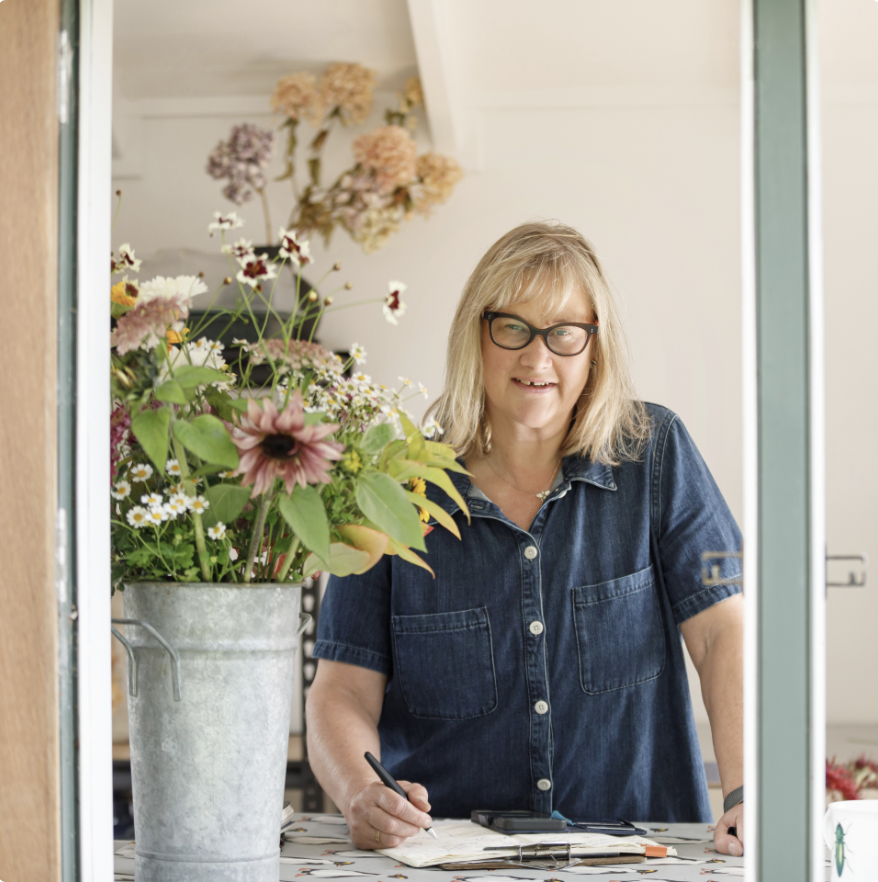
Written by: Julie Treanor - Owner of The Pickery and co-creator of The Floral Business Activator, who has found her place in the flower world and loves it.
Follow Julie on Instagram @thepickery